
Advanced Learning  /  Intermediate Track
Call +91 78925 81597
Intermediate Track  |  Course 4

IoT with Data Science

Real-time sensor data, IoT devices and predictive solutions.

  • 3 Months program with intermediate learning
  • Build industry-oriented projects with expert trainers
  • Certificate on completion, internship opportunity and placement guidance
  • Classroom batch at Balmatta, Mangalore, or live online

Send an Enquiry & Get a Brochure

What describes you best *

Send enquiry
Course Duration3 Months
Time Commitment2 Hours/day
EligibilityPursuing college / Graduate
Learning ModeOnline / Offline
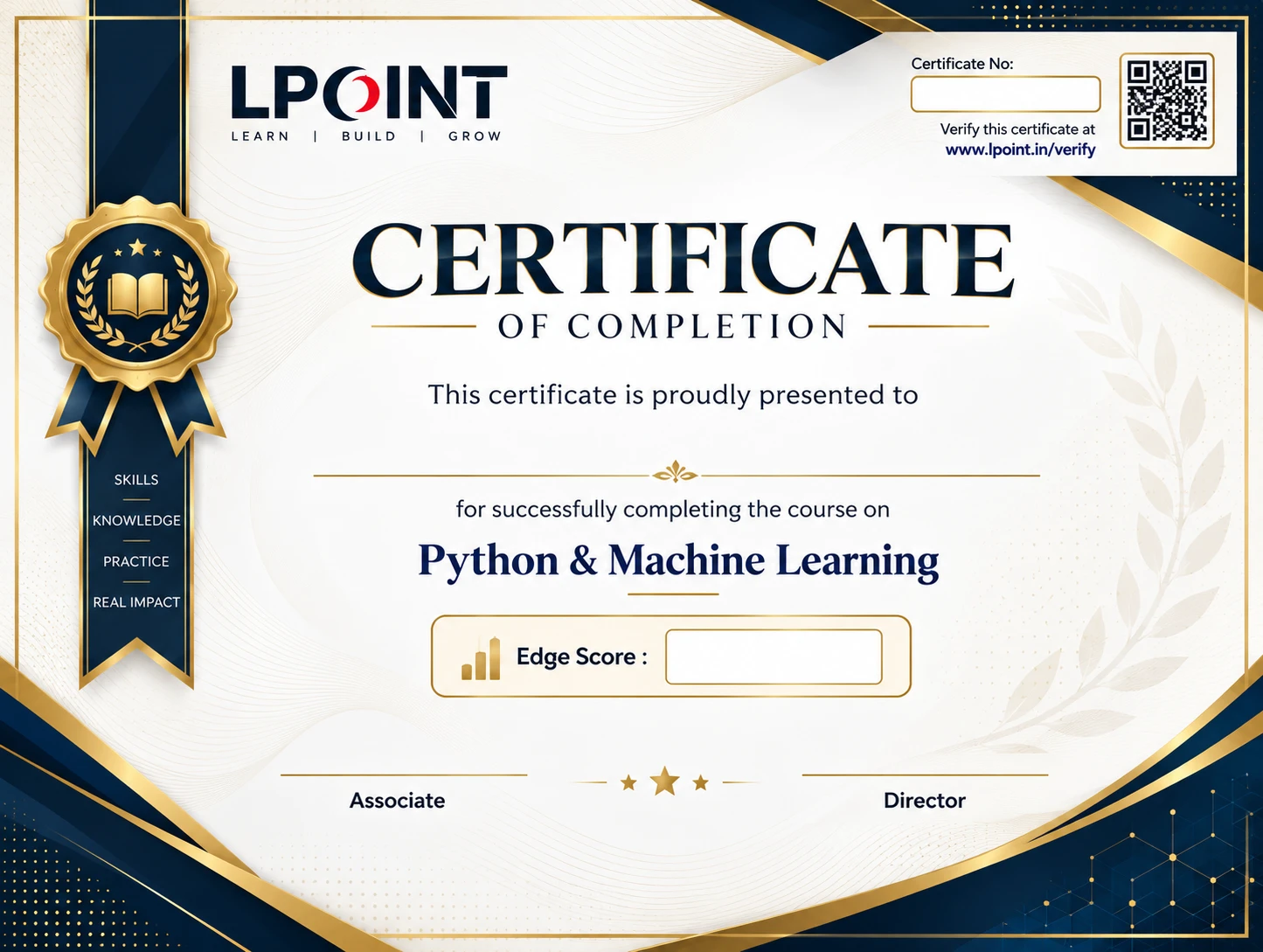
Sample LPOINT certificate of completion with certificate number, QR verification and Edge Score

Why choose this course?

Real-time sensor data, IoT devices and predictive solutions.

Expert Trainers

Learn from experienced trainers who guide you step by step, from the basics to real projects.

Industry-Oriented Projects

Build hands-on projects based on real-world use cases to apply what you learn and strengthen your portfolio.

Placement Guidance

Get help with resume building, interview preparation and job search so you are ready for the job market.

Internship Opportunity

Get an opportunity to gain practical, hands-on experience through an internship after the course.

Certificate on Completion

Receive a certificate on completing the course to showcase your skills to employers.

Face-to-Face Interview with Industry Experts

Take part in a face-to-face interview with industry experts to get feedback and build confidence for real interviews.

What you will learn

IoT devices produce data every second. In this course you will learn how to collect data from sensors, send it to the cloud in real time, store and analyse it, and use machine learning to predict what happens next. The course ends with real-world IoT projects, from device to dashboard.

Students learning together
01IoT Fundamentals
  • IoT architecture and components
  • Devices, gateways and the cloud
  • Real-world IoT use cases
  • Introduction to IoT data
02Sensors & Devices
  • Temperature, humidity and motion sensors
  • Programming boards with Python
  • Reading and logging sensor values
  • Working with ESP32 / Raspberry Pi
03Connectivity & Protocols
  • Wi-Fi and networking basics
  • MQTT and HTTP communication
  • Sending data to the cloud
  • Device security basics
04Real-Time Data & Cloud
  • Streaming sensor data to cloud platforms
  • Storing time-series data
  • Cleaning noisy sensor readings
  • Live dashboards and alerts
05IoT Data Analysis
  • Time-series analysis with Pandas
  • Visualizing sensor trends
  • Spotting patterns and anomalies
  • Descriptive statistics for sensor data
06Predictive IoT Solutions
  • Anomaly detection on sensor data
  • Predictive maintenance models
  • Deploying predictions to a live system
  • Presenting results and insights

Toolkit

PythonESP32 / Raspberry PiSensorsMQTTPandasscikit-learnCloud IoT PlatformGitHub

Industry-oriented projects

01

Smart Environment Monitor

Read temperature and humidity sensors and log the data with Python.

What you will do

  1. Connect temperature and humidity sensors to a board
  2. Read the sensor values with Python
  3. Log the readings with timestamps
  4. Check the data and plot how conditions change

Skills you will use

SensorsPythonESP32 / Raspberry PiData logging
Project outcome

A working monitor that reads temperature and humidity and logs the readings.

02

Live IoT Dashboard

Stream sensor data to the cloud and show it on a real-time dashboard with alerts.

What you will do

  1. Send sensor readings to the cloud using MQTT
  2. Store the incoming data on a cloud IoT platform
  3. Build a real-time dashboard for the live values
  4. Set alerts for readings outside safe limits

Skills you will use

MQTTCloud IoT PlatformDashboardsAlerts
Project outcome

A real-time dashboard that shows live sensor data and raises alerts.

03

Predictive Maintenance Model

Detect anomalies and predict machine faults from sensor data.

What you will do

  1. Explore sensor data from a machine
  2. Spot unusual readings with anomaly detection
  3. Train a model to predict likely faults
  4. Evaluate how early and how accurately it warns

Skills you will use

Pandasscikit-learnAnomaly detection
Project outcome

A model that spots unusual sensor readings and predicts likely machine faults.

04

Capstone: End-to-End IoT Solution

Capstone

Build a connected solution from device to cloud to prediction, such as smart farming or energy monitoring.

What you will do

  1. Choose a use case such as smart farming or energy monitoring
  2. Collect data from sensors and send it to the cloud
  3. Add a prediction model on the collected data
  4. Present the working solution from device to prediction

Skills you will use

SensorsMQTTCloudPredictive model
Project outcome

A connected solution from device to cloud to prediction, presented to an audience.

Who Is This Course For?

Start your Data and AI journey with Python, Statistics, SQL and machine learning.

Degree freshers on campus Students learning together Working professional learning data skills Beginner learning at home

Start your IoT and Data career

  • Open to BCA, BSc (CS), BE / BTech, MCA, MSc (CS) and MTech students and graduates
  • Learn how IoT devices collect data and how that data is analysed
  • Build device-to-dashboard projects for your resume and portfolio
  • Get placement guidance: resume, mock interviews, aptitude and group discussion
What you gain

Real IoT projects and a certificate that help you stand out in campus and off-campus interviews.

Ready for the next level

  • Beginner Track students ready for the next level
  • Build on your Python and Pandas basics
  • Read live sensor data and analyse it with Python
  • Finish with an end-to-end IoT project
What you gain

A smooth step from the basics to working with real-time sensor data.

Add data and AI to your electronics skills

  • Electronics and embedded students curious about data and AI
  • Basic electronics awareness is helpful, but not required
  • Work with sensors and boards such as ESP32 and Raspberry Pi
  • Learn to analyse sensor data and build predictive models
What you gain

The skills to turn data from your devices into live dashboards and predictions.

Combine IoT with analytics

  • Professionals who want to combine IoT devices with analytics
  • Send data to the cloud using MQTT and HTTP
  • Build live dashboards and alerts
  • Knowing Python basics is a plus; new to Python? Start with Course 1: Python for Data Science & Machine Learning
What you gain

A clear path from connected devices to analysis and predictions on real-time data.

Placement guidance

Prepare to take your skills into the job market through:

Resume GuidanceProject PresentationTechnical Interview PreparationMock InterviewsAptitudeHR RoundTechnical RoundGroup DiscussionLinkedIn GuidanceJob Search Guidance

Frequently asked questions

Do I need an electronics background?

No. Basic electronics awareness is helpful but not required. Knowing Python basics is a plus, and basic Pandas is helpful.

Who can join this course?

Degree freshers (BCA, BSc CS, BE/BTech, MCA, MSc CS, MTech), Beginner Track students ready for the next level, electronics and embedded students curious about data and AI, and professionals who want to combine IoT devices with analytics.

How long is the course?

Three months, planned as a 12-week roadmap from IoT basics and sensors to predictive IoT projects.

What if I am new to Python?

Start with Course 1: Python for Data Science & Machine Learning, then join this course.

Will I get a certificate?

Yes. You receive a certificate on completion, and an internship opportunity is part of the program.

Contact Us

Visit us at 6th Level, Oberle Towers, Balmatta, Opp. Juice Junction, Mangalore, Karnataka 575001 · +91 78925 81597 · (0824) 4256456

WhatsApp us

For any queries, you can WhatsApp us at +91 78925 81597

Mail us

For any queries, you can mail us at contact@lpoint.in