Advanced Learning  /  Advanced Track
Call +91 78925 81597
Advanced Track  |  Course 7

Applied AI & Machine Learning Engineering (MLOps)

Model deployment, CI/CD, monitoring and production AI systems.

  • 4 Months program with advanced learning
  • Build industry-oriented projects with expert trainers
  • Certificate on completion, internship opportunity and placement guidance
  • Classroom batch at Balmatta, Mangalore, or live online

Send an Enquiry & Get a Brochure

What describes you best *

Send enquiry
Course Duration4 Months
Time Commitment2 Hours/day
EligibilityPursuing college / Graduate
Learning ModeOnline / Offline
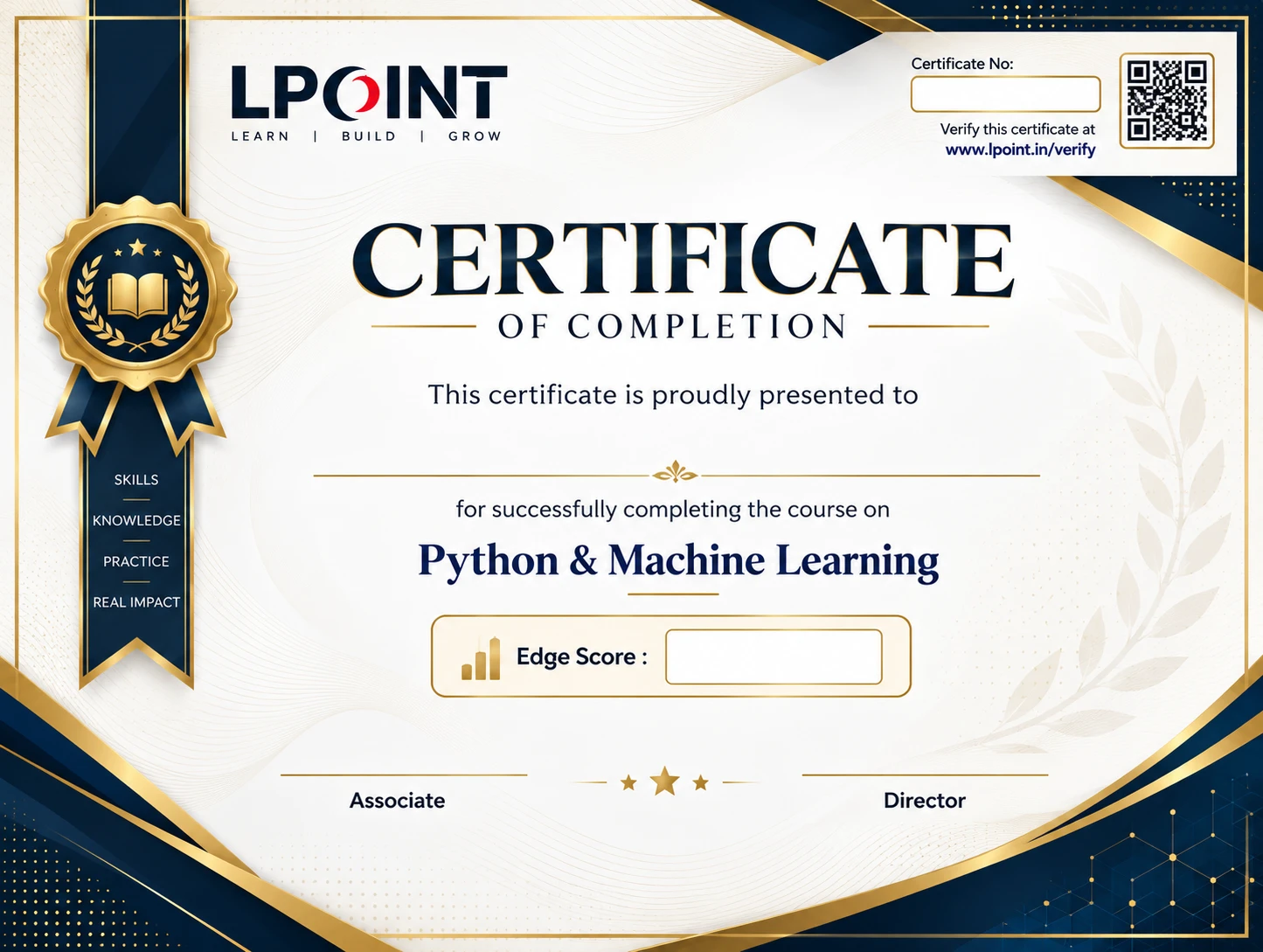
Sample LPOINT certificate of completion with certificate number, QR verification and Edge Score

Why choose this course?

Model deployment, CI/CD, monitoring and production AI systems.

Expert Trainers

Learn from experienced trainers who guide you step by step, from the basics to real projects.

Industry-Oriented Projects

Build hands-on projects based on real-world use cases to apply what you learn and strengthen your portfolio.

Placement Guidance

Get help with resume building, interview preparation and job search so you are ready for the job market.

Internship Opportunity

Get an opportunity to gain practical, hands-on experience through an internship after the course.

Certificate on Completion

Receive a certificate on completing the course to showcase your skills to employers.

Face-to-Face Interview with Industry Experts

Take part in a face-to-face interview with industry experts to get feedback and build confidence for real interviews.

What you will learn

A model only creates value when it runs reliably in production. In this course you will learn how to turn ML code into production-ready systems: tracking experiments, deploying models as services, automating delivery with CI/CD and monitoring them after launch. The course ends with real-world MLOps projects.

Students learning together
01ML Engineering Foundations
  • From notebooks to clean Python code
  • Project structure and packaging
  • Testing ML code
  • Working with Git and GitHub
02Experiment Tracking & Versioning
  • Tracking runs with MLflow
  • Model registry basics
  • Data and model versioning
  • Reproducible experiments
03Model Deployment
  • Serving models with FastAPI
  • Containers with Docker
  • Batch and real-time prediction
  • Deploying to the cloud
04CI/CD for ML
  • Automated tests on every change
  • Pipelines with GitHub Actions
  • Automated build and deployment
  • Safe rollouts and rollbacks
05Monitoring & Maintenance
  • Tracking model performance
  • Data drift and concept drift
  • Logging, alerts and dashboards
  • Retraining strategies
06Production AI Systems
  • End-to-end ML system design
  • Scalability and cost basics
  • Security and access control
  • Presenting results and insights

Toolkit

Pythonscikit-learnDockerFastAPIMLflowGitHub ActionsCloud PlatformMonitoring Tools

Industry-oriented projects

01

ML Model REST API

Wrap a trained model in a FastAPI service that returns predictions on request.

What you will do

  1. Train and save a model with scikit-learn
  2. Build a FastAPI service around the model
  3. Add an endpoint that returns predictions
  4. Test the API with sample requests

Skills you will use

FastAPIscikit-learnREST APIPython
Project outcome

A working API that returns predictions from your trained model on request.

02

Containerised Model Deployment

Package a model with Docker and deploy it to the cloud so others can use it.

What you will do

  1. Write a Dockerfile for your model service
  2. Build and test the container locally
  3. Deploy it to a cloud platform
  4. Call the live service to check that it works

Skills you will use

DockerCloud deploymentFastAPI
Project outcome

A containerised model running in the cloud that others can use.

03

Automated CI/CD ML Pipeline

Set up pipelines that test, build and deploy a model automatically on every change.

What you will do

  1. Add automated tests for your code
  2. Set up GitHub Actions to run them on every change
  3. Build the container automatically
  4. Deploy the new version without manual steps

Skills you will use

GitHub ActionsCI/CDAutomated testing
Project outcome

A pipeline that tests, builds and deploys your model automatically on every change.

04

Capstone: Production ML System

Capstone

Build a complete ML system with tracking, deployment and monitoring, then present your results.

What you will do

  1. Track experiments and model versions with MLflow
  2. Deploy the chosen model as a service
  3. Add monitoring for performance and data drift
  4. Present the complete production system

Skills you will use

MLflowDeploymentMonitoringPresentation
Project outcome

A complete ML system with tracking, deployment and monitoring, presented to an audience.

Who Is This Course For?

Start your Data and AI journey with Python, Statistics, SQL and machine learning.

Degree freshers on campus Students learning together Working professional learning data skills Beginner learning at home

Start your ML engineering career

  • Open to BCA, BSc (CS), BE / BTech, MCA, MSc (CS) and MTech students and graduates
  • Learn how machine learning models are deployed and run in production
  • Build MLOps projects for your resume and portfolio
  • Get placement guidance: resume, mock interviews, aptitude and group discussion
What you gain

Real MLOps projects and a certificate that help you stand out in campus and off-campus interviews.

Ready for production AI

  • Intermediate Track students ready for production AI
  • Prerequisites: Python functions, packages and basic OOP, and training models with scikit-learn
  • Basic Git and command line are helpful
  • Course 2: Data Science & Predictive Analytics is recommended
What you gain

A smooth step from training models to running them reliably in production.

Deploy your models

  • Data scientists and developers who want to deploy models
  • Deploy models as APIs with Docker
  • Track experiments and version models and data
  • Automate testing and delivery with CI/CD
What you gain

The skills to take a trained model from a notebook to a live, monitored service.

Move into ML engineering roles

  • Working professionals moving into ML engineering roles
  • Monitor models and detect data drift
  • Run AI systems reliably in production
  • Online and offline batches with 2 hours of learning per day fit around your job
What you gain

A clear path into ML engineering, from packaging models to monitoring them after launch.

Placement guidance

Prepare to take your skills into the job market through:

Resume GuidanceProject PresentationTechnical Interview PreparationMock InterviewsAptitudeHR RoundTechnical RoundGroup DiscussionLinkedIn GuidanceJob Search Guidance

Frequently asked questions

What should I know before joining?

Knowing Python basics is a plus (functions, packages and basic OOP), along with training models with scikit-learn. Basic Git and command line are helpful, and Course 2: Data Science & Predictive Analytics is recommended.

Who can join this course?

Degree freshers (BCA, BSc CS, BE/BTech, MCA, MSc CS, MTech), Intermediate Track students ready for production AI, data scientists and developers who want to deploy models, and working professionals moving into ML engineering roles.

How long is the course?

Four months, planned as a 16-week roadmap from ML engineering foundations to monitoring and a production capstone project.

Which tools will I learn?

Python, scikit-learn, Docker, FastAPI, MLflow, GitHub Actions, a cloud platform and monitoring tools.

Will I get a certificate?

Yes. You receive a certificate on completion, and an internship opportunity is part of the program.

Contact Us

Visit us at 6th Level, Oberle Towers, Balmatta, Opp. Juice Junction, Mangalore, Karnataka 575001 · +91 78925 81597 · (0824) 4256456

WhatsApp us

For any queries, you can WhatsApp us at +91 78925 81597

Mail us

For any queries, you can mail us at contact@lpoint.in